
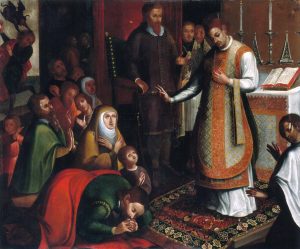
Dom Egas Pais’s penance before Saint Gerald, Archbishop of Braga
Author: Simão Álvares (?)
Date: 17th century, middle
Material: Oil on canvas
Dimensions (cm): H 126,5 x W 151
Provenance: Guimarães, Colegiada de Nossa Senhora da Oliveira
Inventory No.: MAS P 49
On the right side, a clergyman vested with a chasuble and a maniple is with his back turned to an altar. At his feet, lying prostrate on the pavement, a man with a woman and a boy, who are kneeled by his side, are followed by several extras who are also kneeled. In the center, standing, a quite tall male figure, leaning on a leather chair, stands out. In the upper left corner, a devil grabs a man by his hair.
This canvas was entitled as Saint Teutonius celebrating Mass before Dom Afonso Henriques and his retinue. However, Manuela Alcântara dos Santos presents a different proposal, identifying the depicted scene with the episode of Dom Egas Pais’s penance before Saint Gerald, Archbishop of Braga. Among other iconographic aspects, she highlights a detail of the painting that was formerly ignored. In the upper left corner of the painting, an open door frames a fantastic scene that seems to be taking place in another space-time: a man is grabbed by the hair by a demon with horns. Manuela Alcântara Santos associates this canvas with an episode recorded in Saint Gerald’s life, with Dom Egas Pais de Penagate and this archbishop as protagonists. Egas Pais, a nobleman from the time of Dom Afonso VI of León and Castile, lord of the lands of Penagate, near Vila Verde, married a close relative and he was accused of incestuous behavior and, on account of this, he was excommunicated by this same archbishop. One day, when he was celebrating the mass before Count Dom Henrique, Dona Teresa and his retinue, Egas Pais wanted to enter the church and, having been thwarted by the archbishop of Braga and by the Count, he reacted violently, being possessed by a demon. Saint Gerald’s life records that, at the end of the mass, the lord of Penagate threw himself at the saint’s feet and he admitted that he had done wrong and he asked for forgiveness, being accepted by the saint who imposed him a penance.
This canvas, together with three others (MAS P 46, MAS P 47 and MAS P 48), originates from the decorative program of the Colegiada de Nossa Senhora da Oliveira, which was dismantled with the rebuilding works of 1675 and they are probably from the time of the prior Dom Diogo Lobo da Silveira, who, so vehemently, endowed the temple with explicit references to the mythical history of the place, in a context of nationalist representation. These canvases attest to propagandistic goals of the rhetoric of the Restoration, contributing to the nationalist exaltation motivated by the time of war against the Philippine troops.