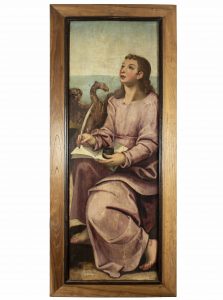
Saint John the Evangelist in Patmos
Author: Unknown
Date: 17th century, beginning
Material: Oil on chestnut
Dimensions (cm): H 138 x W 48,5
Provenance: Guimarães, Brotherhood of Nossa Senhora do Carmo da Penha
Inventory No.: MAS P 59
In this panel, Saint John the Evangelist is dressed in red, barefooted, sat, writing with a quill on a book that rests on the right knee and holding an inkwell. An eagle, his symbol, is depicted with open wings.
Author of the fourth Gospel, Saint John also wrote the three Epistles of John (1, 2 and 3) and the Book of Revelation.
After the 5th century, the four evangelists are represented by symbols in the shape of living beings: the man represents Matthew, the lion Marcus, the bull Luke and the eagle John. These representations are designated as tetramorph, a word that is formed by a prefix of Greek origin, tetra, which means “four” and by the term morphé, which means “shape”, thus, meaning the four symbols of the evangelists. The tetramorph is originally referred to in the Book of Revelation by John (Ap 4:6 – 9) who is inspired by Ezekiel (Ez 1, 1 – 28).
Of the four evangelists, only Matthew and John met Jesus personally, as they were His apostles. Marcus and Luke didn’t meet Him and wrote their gospels in the second half of the 1st century.
This panel and another one (MAS P 58) of local origin depicting episodes of the Life of Saint John the Evangelist are part of the permanent exhibition of the museum. According to Vítor Serrão, these Mannerist works, of a very conventional execution, follow Nordic Mannerist prints inspired by Martin de Vos (1532 – 1603).